6 lessons Valorant players can take from a lowest to highest rank climb
Need articles like this for your video? They help promote it on YouTube and Google — order them in the Telegram bot @sat_sit_bot. Articles with your video embedded are written and posted by the bot itself — on popular topical sites (no ads). Free trial — 50 articles.
Key takeaways
- The challenge format is a climb from the lowest rank tier to the highest, played across multiple accounts and lobbies rather than a single smurf session.
- A Cypher player in the opening match tilts over missing voice comms, blames teammates and invents calls that were never made.
- A Reyna ends up being the most reasonable voice in one lobby, which flips the usual stereotype about duelist mains.
- Timmy's account stats jump around wildly between games, including a scoreline of roughly 30 kills to 4 deaths in one Ascendant-level match.
- Viewers flag a possible bug where a kill on Clove does not refresh an ultimate, plus questions about sensitivity, DPI and frame rate.
Valorant is a tactical 5v5 shooter where rank is decided less by raw aim than by how consistently you convert advantages, communicate and reset after mistakes. A lowest-to-highest rank climb compresses that lesson into a handful of matches: the same player meets Iron-level chaos and Radiant-level discipline in the same session, and the difference is usually mental, not mechanical. The full run is streamed live on Twitch, where you can watch the climb continue in real time.
What a lowest to highest rank challenge actually tests in Valorant
The format removes the variable of talent and leaves only adaptation. A player starts in the bottom tiers, where teammates hold odd angles, buy without a plan and rarely trade, then moves upward into lobbies where every default is contested and every ultimate is tracked. The challenge is not "can a good player win in Silver" — it is "how quickly can a good player stop playing like the lobby and start playing like the rank above it."
Three things get exposed along the way:
- Patience. In low lobbies, over-aggression works, which teaches bad habits that get punished two tiers later.
- Communication. Callouts that are ignored in Iron become mandatory in Diamond and above.
- Emotional reset speed. One tilted teammate can cost more rounds than a bad aim day.
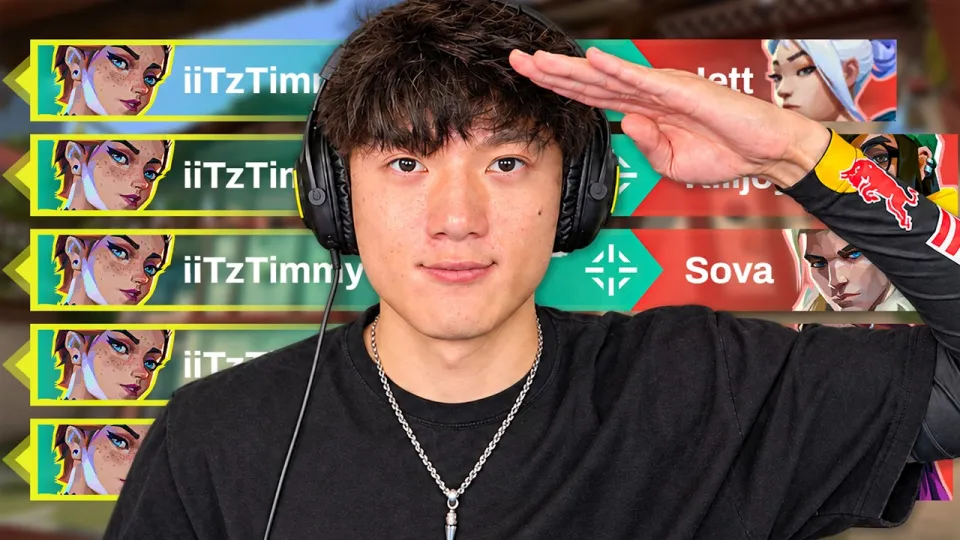
The iiTzTimmy Two upload of the challenge shows exactly this: dominant individual scorelines sitting next to rounds lost to nothing more complicated than a teammate who stopped listening.
Why the tilted Cypher is the most instructive player in the run
The opening match is dominated by a Cypher who spirals over voice comms. He is first onto site, dies, and then blames the team for not following — while simultaneously criticising everything his teammates do and calling out information that was never given, including a cage that nobody placed. That combination is the clearest example of a broken mental loop in Valorant.
The pattern is worth naming because it repeats at every rank:
- Selective memory. He remembers the rounds where he entered alone and died, not the rounds where his team won without him.
- Invented comms. He hears a call that was never made, then treats the silence as betrayal.
- Nitpicking as a substitute for a plan. Criticising teammates is easier than deciding what the next round should look like.
What makes it instructive rather than just funny is the cost. A player in that state stops processing real information, so even correct calls get filtered out. Viewers in the comments point out that he should step away from the game for a while — that is genuinely the correct fix. A five-minute break between matches resets more rounds than a new crosshair.
The Reyna being the sensible one and other role surprises
Stereotypes about agent roles collapse fast in mixed lobbies. Duelist players get tagged as selfish and aggressive, controllers as passive, sentinels as overly cautious — and then a Reyna ends up being the calmest voice on the team, tracking economy and calling rotations while everyone else argues.
That matters for anyone grinding ranked in Valorant because role labels are a poor predictor of who will actually lead. What predicts it is whether a player treats the round as a shared problem. A Reyna who waits for a flash to land before entering is more useful than a Sentinel who refuses to leave the site. Judge teammates by behaviour in the current match, not by the agent portrait on the scoreboard.
The same logic applies to the second lobby in the run, where opponents are visibly desperate for a highlight and over-peek constantly. Recognising that pattern — players who need the kill more than the round — is a free source of advantages at any rank.
Aim, sensitivity and hardware questions that always come up
Mechanical questions dominate the comment sections of every Valorant climb video, and they deserve a straight answer: sensitivity and DPI are personal, and copying a pro's numbers without copying their mousepad space, grip and monitor distance rarely transfers.
A practical approach for anyone climbing:
- Pick an effective DPI (mouse DPI multiplied by in-game sensitivity) in a comfortable band and keep it fixed for at least two weeks.
- Test it in Deathmatch and Aim Lab-style routines rather than in ranked, so you are not relearning during matches that count.
- Adjust by small increments — large jumps reset your muscle memory and cost more than they gain.
- Treat frame rate as a separate variable. Smooth, high-refresh performance changes how confidently you hold angles, and it is not a substitute for crosshair placement.
One viewer also flags a possible bug where an ultimate does not refresh after a kill on Clove. Whether or not that interaction is intended, the takeaway is the same: when something behaves unexpectedly, check the current patch notes before assuming your mechanics failed.
Reading scorelines and stats without fooling yourself
The run contains a match where the scoreline reads roughly 30 kills to 4 deaths at an Ascendant-level lobby — the kind of line that looks like proof of smurfing and is really proof of a good day plus a favourable matchup. Individual stats in Valorant are noisy. A 30/4 game and a 15/15 game can come from the same player in the same session.
What to look at instead:
- First-blood and first-death counts, which say more about map control than total kills.
- Clutch and trade rates, because they show whether rounds are being won as a unit.
- Round win rate on attack versus defence, which exposes where a player's defaults break down.
A single explosive scoreline is a highlight, not a diagnosis. The climb is the data set, not any one map.
Common questions from the climb answered plainly
Viewers watching a low-to-high rank run tend to ask the same few things, and the answers hold regardless of who is playing.
- Does a high rank guarantee wins in low lobbies? No. Low-tier matches reward patience and self-sufficiency; a player who expects trades and setups will lose rounds to teammates who simply do not provide them.
- How much do comms matter? Enormously, but only if they are accurate. Invented or panicked calls are worse than silence because they force teammates to second-guess real information.
- Is it worth playing when tilted? Almost never. The Cypher sequence is the clearest illustration: the moment a player starts narrating blame instead of the next round, the match is already gone.
- How do you handle opponents chasing highlights? Let them. Players who need the kill will re-peek, over-extend and hand you free trades.
Useful links
- Live streams and the ongoing climb: https://www.twitch.tv/iiTzTimmy
- Short updates: https://twitter.com/iiTzTimmy
- Clips and behind-the-scenes: https://www.instagram.com/iiTzTimmy/
- Short-form highlights: https://www.tiktok.com/@iiTzTimmy
- Community and matchmaking talk: https://discord.gg/iitztimmy
- Full channel: https://www.youtube.com/c/iiTzTimmy
- Second channel with challenge runs: https://www.youtube.com/channel/UCQldhsqGcoJuyqU-26cvcjQ
- Clips channel: https://www.youtube.com/channel/UCRjsH98Vs3B-2QgFEFArE9A
- Japanese-language channel: https://www.youtube.com/channel/UCSQqxSoBS2RXTxSefnc1jXA
Final thoughts on climbing in Valorant
A lowest-to-highest rank run is less a demonstration of skill than a stress test of habits, and the most memorable moments in this one are not the frags but the tilt. The Cypher who argues with silence and the Reyna who quietly holds the team together are two versions of the same lesson: the player who processes information wins more rounds than the player who narrates blame. Aim, sensitivity and frame rate matter, but they are multipliers on top of a stable mental state, not replacements for it. This breakdown comes courtesy of the iiTzTimmy Two channel, where the challenge run is published in full — and if you want to watch the next stage live, head to Twitch and follow along.
Questions & answers
What is a lowest to highest rank challenge in Valorant?
It is a climb format where a player starts in the bottom rank tiers and works upward through the ladder, usually across several accounts or sessions. The point is to show how playstyle has to change between Iron-level chaos and high-rank discipline, rather than to prove that a strong player can beat weaker opponents.
Why do high-rank players sometimes struggle in low lobbies?
Because low-tier matches do not reward the same habits. Setups built on traded utility and coordinated entries fall apart when teammates do not follow, so a strong player has to play more self-sufficiently and take fewer assumptions for granted. That adjustment period is where most of the lost rounds come from.
How important are voice comms compared to aim?
Accurate comms decide more rounds than raw aim at most ranks, but inaccurate comms are worse than none. Calling information that was never given, or blaming teammates instead of describing the next play, forces everyone to second-guess real calls and costs rounds that were otherwise winnable.
Should I copy a streamer's sensitivity and DPI?
Only as a starting reference. Effective DPI depends on your mousepad space, grip and desk setup, so copying numbers without copying the environment rarely transfers. Pick a comfortable value, keep it fixed for a couple of weeks, and test changes in Deathmatch rather than in ranked matches.
Source: I Might Be Getting TOO Good at Valorant… (Lowest To Highest Rank Challenge) · Markdown version